Payroll Tax Hangover Is Coming: Largest Payroll Tax Hike In Eleven Years To Take Effect On January 1st
- CTF releases 11-year trend analysis of payroll tax hikes
- Average worker to pay $157 more in payroll taxes in 2002; largest hike in 11 years
- Workers now paying $727 more than 1992 while employers fork out an extra $628
- EI fund surplus projected to tally over $41 billion by March
Chart #2 Employment Insurance Taxes: 1992-2002 for employee earning $41,000
Chart #3 CPP Taxes: 1992-2002 for employee earning $41,000
Chart #4 EI and CPP Taxes: 1992-2002 for employee earning $41,000
OTTAWA: The Canadian Taxpayers Federation (CTF) today released an eleven-year analysis of payroll taxes paid by Canadian workers and employers along with calculations highlighting the extra payroll tax burden to be borne by workers and companies next year.
Biggest Payroll Tax Hike Yet
"Taxpayers better stock up on the Tylenol or Ibuprofen now because 2002 brings with it a whopping payroll tax hangover," stated CTF federal director Walter Robinson. "While EI taxes are dropping by a nickel or a modest 2.2%, CPP premiums will skyrocket by 11.8% or 40 cents for each $100 of earnings. Bottom line: workers will fork out as much as $157 more next year in payroll taxes."
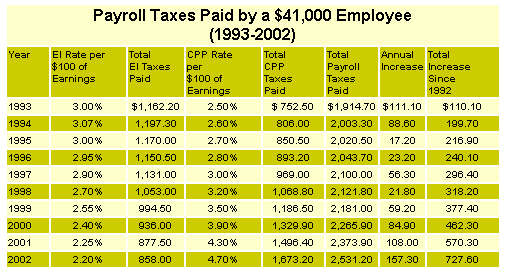
"The 2002 hike represents a 6.6% increase over last year and a 40% jump since 1992," added Robinson. "Payroll taxes are profit insensitive job killers. And in the midst of a recession, Ottawa should not be punishing workers and employers who are needed to pull the economy out of its dismal state. It's a bizarre way to bring in the New Year."
Contrary to Common Sense
The CTF also pointed out that even Finance Minister Paul Martin believes - or at least he used to - that rising payroll taxes are a fundamental economic problem. On October 17, 1994, Minister Martin told the Toronto Star, "we believe there is nothing more ludicrous than a tax on hiring. But that's what high payroll taxes are. They have grown dramatically over time. They affect lower wage earners much more than those at the high end."
"The federal government has exhibited great hypocrisy on the issue of payroll taxes. They say one thing, but tax another," added Robinson. "This hypocrisy has hit one in five Canadians who are self-employed doubly hard as they pay both the employee and employer contributions for CPP and EI."
The EI Surplus
"All the more discouraging is the fact the government continues to benefit from the EI cash cow as the EI fund surpluses are rolled into consolidated general revenues," said Robinson. "By March 2002, the current $35 billion surplus in the EI account will probably grow to $41 billion."

"Payroll taxes hurt Canadian workers and damage our economy. They specifically and punitively punish middle-income and lower-income workers," Robinson concluded. "It's obvious that Mr. Chretien and company didn't make a new year's resolution to help Canadian workers."