Some Thoughts on Exorbitant Chief and Council Pay
I don’t really have time for people who try and justify the exorbitant pay levels some chiefs and councilors on aboriginal reserves are making.
If they sat in my chair for a week or two and heard some of the struggles from the grassroots they may not be so foolish as to try and defend some of the more greedy chiefs and councilors out there who are blatantly ripping off their own people and taxpayers. However, as some keep defending the greed and nitpicking over our numbers I thought I would write a post that offers some food for thought on the issue.
To begin, consider what’s happening on the Standing Buffalo First Nation, a small community of 443 people about an hour north east of Regina.
Grassroots band members described to me how the community has a youth suicide problem. Yet, when some people approached the band office to get some money to fund a prevention program (I think it was for holding a couple seminars) they were told there was no money available. Sadly, another young person from that community took his own life just a couple months ago.
Some young men from the community were also told there was no money to help them take a couple short training courses; they wanted to go and work in the oil patch.
So what did the band have money for?
If you guessed “exorbitant pay for the chief and council” you would be correct.
How do we know this?
Because a good lady named Stella Isnana was elected last year to the band’s council. After settling in, she was told of the huge sums of pay she would be receiving as a councillor. Shocked by the news, Isnana told the band the pay amounts weren’t appropriate and eventually went to the media with the jaw dropping numbers. She also notified the band’s senate as well.
The senate then requested a meeting with the chief and council to explain what was going on. They sat around all day waiting, but as the chief and crew refused to show up, the Senate impeached the whole lot of them.
In terms of the actual pay numbers, you can see them all posted here. In short, the chief made $174,862 from the band (plus travel expenses) while five of the six band councilors received between $120,161-149,503 (plus travel expenses). A sixth councillor made $113,664, but he only served eight months.
It should be noted the chief also received another $19,875 from the Federation of Saskatchewan Indian Nations (FSIN) and Battlefords Agency Tribal Chiefs Inc. He sits on those publicly funded boards because he’s the chief of his community. This would be like Brad Wall getting paid extra to attend a premier’s conference or a meeting with western premiers. Wall doesn’t get extra pay for those meetings as he’s already getting paid a salary to be premier, but chiefs often draw extra income from these external bodies (even though many are already getting paid a salary on top).
What’s important to note is that each of the aforementioned chief and council pay figures are tax-free. Yup, no income taxes taken off their pay cheques.
Thus, whenever we discuss chief and council pay numbers publicly we take those tax-free numbers and use Ernst and Young’s Personal Income Tax calculator to figure out what those pay levels are for someone off reserve and paying income taxes. The calculation may not be accurate to the penny, but it gives you a good idea as to what the numbers roughly look like for people off reserve. After all, Ernst and Young didn’t become one of the most respected accounting firms in the country by doing shoddy work.
Once you plug the Standing Buffalo pay numbers into E & Y’s tax calculator it looks like this:
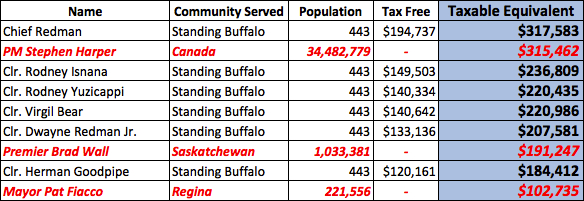
As you can see the chief made slightly more than the prime minister and the four full-year councillors made more than Premier Brad Wall. The crew from Standing Buffalo also made way more than Pat Fiacco, Mayor of Regina at the time (a city with more than 200,000 people).
So why did we compare the figures to provincial premiers and the prime minister?
To the show the absolute absurdity of what is happening on some reserves.
After all, the average reserve has around 1,000 people or so living on it. Why should taxpayers pay for politicians in those communities to make pay levels anywhere close to what a provincial premier (most serve more than 1 million people) or the prime minister (serves over 34 million people) make? Exorbitant chief and council pay certainly wasn’t in the treaties.
Many grassroots band members also take offence to the high pay numbers as those dollars could be used to help fix up moldy homes and address various other problems in the community.
Some rebut our numbers by saying things like “but being a chief is more than a full time job” or “yeah but you didn’t include the prime minister’s pension or other perks like his rent-free house.” One has even raised the fact the prime minister gets to fly around in a private jet.
Again, defenders of the corrupt behavior are missing the point. It’s absurd for a small community’s chief to be paid anywhere close to the pay given to a politician who was elected to serve 1 million plus people – or even 200,000 plus people (in the case of Regina’s mayor).
If we start quibbling about the jet the prime minister gets to fly on I think we’ve all missed the point – but don’t take my word for it, ask those trying to get support at the grassroots level. Ask the mom who can’t get funding to get a youth suicide prevention program off the ground what she thinks? Ask her if she thinks her small community’s leader should get paid roughly the same as someone who serves 34 million people.
As for the suggestion that ‘chiefs work hard,’ join the club! Lots of people do. Try asking small business owners what their days are like. Most bust their butts to keep things going when employees call in sick, when emergencies come up, etc. They definitely are working a lot more than 9-5 and many can only dream of making half the money some chiefs receive.
And speaking of pensions, the reality is 76% of private sector employees in Canada (Statistics Canada data) have no workplace pension at all, so I doubt that argument resonates with a lot of people. Sure, federal politicians have rich pension plans, but it doesn’t mean it’s right. In fact, we’ve been fighting that battle for years too.
Some will argue that chiefs and councilors should receive pay levels that are on par with small town councils. However, as it stands right now, the role of many chiefs and councilors is different – they’ve made the work into full-time jobs whereas small town reeves and councilors are often part-time gigs on the side.
Personally, I think many reserves should follow the municipal model and convert their councils into part-time, oversight boards. The chief and council could make a small sum for providing direction to the band’s administration just like small town councils do. In some cases, that would allow bands to save a small fortune and put those resources into paying qualified officials to teach, work on addressing health problems in the community, pursue economic development opportunities, etc. However, reforming the role of reserve councils is a whole different story.
Travel
Another aspect that needs to be addressed is that when “travel” is noted on a pay sheet, sometimes it represents a reimbursement for travelling to a meeting whereas other times it represents a flat amount per month to cover travel. It can also represent a reimbursement for travel expenses, plus extra pay for attending meetings.
For example, when you go through these numbers, you’ll find a chief on page three who is earning $94,080 in the “travel/per diem” column. Thus, it’s probably fair to assume a good portion of those dollars is pay for going to meetings (on top of the $118,398 in tax-free salary).
Hiding the Details
I want to note loud and clear – once again – that we’ve never suggested every chief and councillor in Canada is making a fortune. Scan the numbers we released in 2010 and anyone can see that’s clearly not the case.
Sure, you can’t take all those numbers at face value – you have to make conversions to taxable equivalent salaries and probe some of the “travel” figures. In some cases you have to do more digging, as the figures are simply wrong; and don’t include cash advances certain individuals have taken. But you will see there are plenty of chiefs and councilors out there who aren’t making a fortune for the work they do.
However, our biggest beef since we started pushing hard on the chief and council pay issue back in 2009 was that many chiefs and councilors set their pay behind closed doors and then hid the info from their own band members.
Many band members told us they would ask for their council’s info from their band office, but were refused the data. They would then ask Federal Aboriginal and Northern Development offices for the information only to be told “go back and ask your band for the info.” Thus people would get caught chasing their tails and often not receive the information.
We’ve pushed federal bureaucrats hard to stop playing games and start handing those annual audits (which include chief and council pay info) out to band members who ask for it. Thankfully, things seem to be getting better.
Of course we’re also closer to the passing of Bill C-27 – legislation that will put chief and council pay information online for every reserve in the country. It won’t solve all the problems on reserves, but it will help band members and taxpayers know more about where the money is going.
Thankfully, we’ve already seen several cases where band members voted out greedy chiefs and councilors after we helped expose their outrageous pay levels. A little transparency can go a long way, just ask the people of Glooscap (NS), Annapolis Valley (NS) and Standing Buffalo (SK) to name a few.
Yes, that’s right, to complete the story of the latter, they just voted in a new chief and council. Good luck to the new council!
Transparency won’t solve all the problems on reserves, but it will continue to help band members turf out some of those that are more interested in filling their pockets with money than serving the community.
As for those on the sidelines quibbling – good luck to you. The transparency train has already left the station whether you like it or not.
.